Is It Okay to Use AI in Ministry?
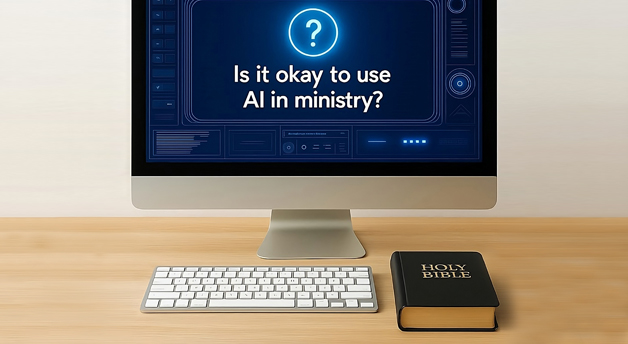
Artificial intelligence is no longer science fiction but has become part of everyday life through smartphones, televisions, wearables, home appliances, e-commerce, and social media platforms. Some public leaders have raised concerns about the risks of AI, prompting world governments to create policies for the ethical use of AI systems. With the various concerns and the growing use of AI in society, church leaders are asking the question, “Is it okay to use AI in ministry?”
The Peril of AI
Artificial Intelligence is a powerful tool with many perils if not properly used. The first caution is the fine line between delegation and dependency. Delegation is using a calculator to save time, but dependency is forgetting how to do math altogether. An MIT research study, “Your Brain on ChatGPT,” found that 83% of people who used ChatGPT to write essays could not recall the content they wrote minutes later. Information transferred but not learned leads to “cognitive atrophy.” Just as muscles weaken from lack of use, so do mental skills when critical thinking and concentration are consistently off-loaded to a computer.
The danger of habitual dependence on AI goes beyond mental concerns and impacts a person’s spiritual well-being. Trials and hardships build character, endurance, and maturity (Romans 5:3–4; James 1:2–4). Engaging and wrestling with Scripture for sermon or lesson preparation deepens understanding, strengthens faith, and promotes spiritual growth. AI short-circuits this process by offering instant answers. Using AI for critical thinking and problem-solving is like using a computer to play chess for you. The computer may win all your chess matches, but did it make you a better chess player? Spiritual growth requires personal struggle.
While AI is quasi-omniscient, it is not infallible. AI models can generate “hallucinations,” which are inaccurate, inconsistent, or completely fabricated information presented as fact. Users must double-check and verify the information provided. AI algorithms have the potential to introduce bias that may mislead or undermine Christian values. One suggestion is to prompt AI to “assume an open frame” at the beginning of a conversation. This setting prevents AI from limiting responses to only mathematical, scientific, and rational views.
The Promise of AI
AI can be a very promising tool when used responsibly and ethically. Some practical uses of AI include media generation. Pastors can create images for their sermons, helping the congregation to visualize biblical scenes and bring the stories to life. AI is a great research assistant for finding sources, quickly gathering information, and analyzing large data sets. For example, if a student is researching a subject, they can ask ChatGPT about the leading thinkers and subject matter experts of the particular topic, along with books and journal articles they’ve written.
Many AI tools for research are emerging. NotebookLM, developed by Google, is a powerful AI-powered research assistant that summarizes and organizes information from documents, websites, and YouTube videos provided by the user. Unlike ChatGPT, which relies on a broad dataset, NotebookLM focuses only on user-provided sources for more targeted research.
Another practical use of AI is the advancement of Bible translation, which has proved invaluable in the mission field. Computer software significantly improved the efficiency and accuracy of Bible translation work into other languages. AI can also translate sermons and Gospel conversations into various languages in real time.
The Path of Discernment
As technology continues to advance, the challenge lies in exercising discernment to avoid the extremes of total adoption or overall rejection of AI. Ministers need to adopt an “AI-enhanced,” rather than “AI-dependent” mindset. Pastors must be cautious that delegation does not turn into dependency (AI cannot replace the Holy Spirit in illuminating Scripture). Technology should be used where it adds value rather than simply adopting technology for technology’s sake. Proper use of AI should support and not replace ministry tasks to allow the pastor to focus on pastoral care. The biblical principle of stewardship encompasses all assets placed under one’s care, which includes people, money, time, talents, and resources, including technology. As faithful stewards, Christians are called to manage technology with integrity, wisdom, and accountability.
The image above was created using AI image creation technology.

In this special Light the Way Q&A series, we ask our world-class faculty to shed biblical light on a wide assortment of questions that you and your church might encounter in life and ministry. Each answer is shaped with a biblical worldview and aimed at helping you apply God’s Word to real-world issues.